Tag: Project Management

  • Impact of stakeholder management on the success of a construction project

    Impact of stakeholder management on the success of a construction project

    Most formal sources, such as the Project Management Institute (2001), define stakeholders as: “individuals and organisations that are actively involved in the project or whose interests may be positively or negatively affected by project implementation or successful project completion”

    The success of any project depends on a number of factors:

    • Clear objectives
    • A realistic project schedule
    • Budget
    • Resources
    • Risk and uncertainty management.

    However, the positive outcome of a project depends not only on processes but also on people.

    Stakeholders in a project can be divided into two groups: Internal stakeholders of the organisation, for example, the team members of the project or those who provide funding for the project. External stakeholders are the people who are affected in some way by the project.

    In most projects in the construction sector, there are a variety of stakeholders, and the diversity of their nature and requirements creates a conflict of interest.

    The checklist of stakeholders in a construction project is often extensive and includes facility owners and users, project management, team members, facility managers, designers, shareholders, public administration, employees, subcontractors, service providers, competitors, banks, insurance companies, media, community representatives, neighbours, the public, customers, and regional development agencies.

    Each of them could have an impact on the project’s progress at some point. Although some of them may influence the project more than once, the majority of them will do so at some point in time.

    Stakeholders will determine the success or failure of your project. Here are the main reasons why they are the key players in the project:

    Proper stakeholder management ensures risk-free project delivery

    Risks cannot be completely eliminated, but if you engage stakeholders, you can manage project risks much more successfully. Lack of interaction with stakeholders or their inadequate engagement can confound construction program management.

    Their needs, status, and expectations can change at any point during project execution, which in turn can significantly impact project structure, terms, schedule, and deliverables.

    Stakeholders are a source of project-related knowledge

    In theory, a project manager (PM) should have industry, product, and some technical knowledge, but in reality, they often do not have enough information to compile project requirements and identify constraints. In this case, PMs involve stakeholders and share with them all the important project-related data.

    Stakeholder involvement ensures project execution

    When your project’s stakeholders are aware of every detail, they are more likely to help you complete the project on time and within budget.

    To ensure project success, as a project manager, you need to know who they are and meet them face-to-face to build a working relationship. Those organisations that manage their stakeholders better guarantee big gains in their results over time.

    The key points of stakeholder management in the construction industry along with their impacts are as follows:

    1. Create a detailed stakeholder management plan
      Impact: All stakeholders are properly informed about all relevant stakes
    2. Create a matrix of stakeholders based on Power and Interest
      Impact: PMO would know who the major stakeholders are and who needs to be managed better.
    3. Follow the stakeholder matrix.
      Impact: PMO would know who to inform, consult, collaborate and involve at what phases.
    4. Interview stakeholders during the design phase.
      Impact: Gathering of knowledge, fixing scope.
    5. Ensure transparency.
      Impact: Fewer changes in scope, better acceptability.
    6. Use effective communication methods.
      Impact: All communications are tracked, and no stakeholders are kept in the dark.
    7. Use soft power.
      Impact: Many conflicts which might impact the project can be managed.
    8. Use automated tools and techniques.
      Impact: Ease of communication and less personnel needed for disseminating information.

    Modern construction management studies have seen that there is a better success rate of projects if the above tips are followed.

    Stakeholder management is vital for project success
    project success

    Stakeholder management is a crucial aspect of the success of construction projects. Stakeholders have different interests, expectations, and influences on the project outcomes. Therefore, it is important to identify, analyse, and engage with them effectively throughout the project lifecycle.

    By doing so, PMs can reduce conflicts, enhance collaboration, and increase satisfaction among all parties involved. Stakeholder management can also help achieve project objectives in terms of quality, cost, time, and scope.
  • Effects of Lean Construction Management

    Effects of Lean Construction Management

    Lean Construction is a method for designing production systems in the construction industry with the goal of reducing time, effort, and material waste.

    This type of construction ensures that a project is completed quickly and that fewer costs are incurred during the construction process. Additionally, Lean Construction aims to maximise the value and minimise the costs associated with maintaining, designing, planning and activating construction projects. Globally, the use of Lean Construction increases the productivity of the construction industry.

    Lean Construction has the following key characteristics:

    • Parallel design and construction.
    • Explicitly defined goals for the delivery process.
    • Use of project control consultancy over the entire life cycle of the project from design planning to delivery.

    All people involved in the lean construction project, from the constructors, architects, designers, and owners, to the final construction crew, are considered to ensure that the construction project is of high quality, delivered faster, and costs less.

    Lean thinking principles are applied in the implementation of Lean Construction. The application of lean design principles results in a highly profitable and flexible company.

    These principles include:

    • The customer perspective is considered when defining the design value of the construction process:  Ideas that result in large performance gains are considered to improve the performance of the construction project.
    • Proactive implementation of project cost and control management: Measurement of project planning performance based on results achieved. A metric is used to define planning to be used in lean construction.
    • Expertise takes precedence in solving a problem that can be solved in a day versus the normal process used to solve the same problem in a week.

    Benefits of Lean Construction Management:

    • Generation of quality profit margins
    • Fast realisation of investment
    • Better use of materials and time
    • High Safety methods
    • Fewer scope changes
    • Protecting the environment and respecting workers provides a better social infrastructure

    Lean design and construction are important as capital goods are built in an organised manner. The results achieved impact everyone involved in the construction process. Starting with the savvy owners of the structure to the users of the built facility.

    Tenants living in a building built using the Lean Design approach can realise significant savings in rental costs compared to a traditional approach. This is because the cost and break-even point of implementing the Lean Design approach are conceivably low.

    The lean design approach focuses on sustainable building practices that preserve the environment and ensure green business practices. This method also takes advantage of solar energy, maximising energy use in the design of the building floor plan.

    Additionally, the implementation of Lean Design results in minimal construction waste and byproducts that are not harmful to the environment. The end results are beneficial to both direct and indirect community stakeholders.

    Lean construction designs lead to competition among construction suppliers. Domestic contractors who are in a better competitive position improve the local economy and create new jobs.

    Also, Lean construction has many similarities with BIM, as both aim to optimise construction projects. BIM was introduced as a solution to inefficient construction projects and was gradually adopted by the architecture, engineering, and construction (AEC) industry in the mid-2000s .

    It has been shown for years that the appropriate implementation of BIM can significantly improve the performance and productivity of construction projects. BIM Technologies also helps the design team detect errors using digital models, which helps avoid conflicts and identify overlaps and disruptions during the design and construction phases.

    Lean construction makes projects more efficient

    Lean Construction is a method that strives to eliminate waste and enhance value in the construction industry. It involves the integration of all stakeholders, the clarification of objectives and expectations, and the application of lean thinking principles.

    In the long run, Lean Construction can lead to faster delivery, lower costs, higher quality, and greater customer satisfaction.

  • Advantages of applying agile project management techniques to construction projects

    Advantages of applying agile project management techniques to construction projects

    Agile project management in the construction industry is a process of performing tasks in an orderly and agile manner to ensure proper time management and cost control on ongoing projects.

    It breaks down large projects into smaller tasks and focuses on continuous communication and collaboration between teams such as contractors, stakeholders, workers, suppliers, and consultants.

    This agile methodology helps mitigate risks associated with contract negotiations, schedule delays, changes in project scope, and more through shortened, iterative development cycles while being flexible enough to adapt to changes that occur as the project progresses.

    Agile project management in construction allows you to quickly assess potential issues before they arise and adjust workflows accordingly without sacrificing productivity or quality.

    A construction project is generally managed in a sequential manner. The typical life cycle of a construction project typically goes through the following phases:

    • Design
    • Pre-construction
    • Procurement
    • Development
    • Post-Construction & Operation

    Before the design phase can begin, there is usually a shorter conceptual design phase where the requirements for the project are gathered.

    The entire process is linear, meaning that one phase must be completed before the next begins. In common parlance, these phases in a project plan are called phase gates.

    Agile project management can be applied in the planning phase, which consists of design and pre-construction. Here, the focus of Agile construction teams is to create an iterative work process, often delivering value as they adapt to change. Using sketches, site plans, and so on, they try to gather initial customer feedback as quickly as possible to ensure that requirements have been properly communicated.

    This allows them to adapt to changes early on, which is an industry like construction that is much more cost-effective than reworking later.

    The benefits of agile management in the design phase of a construction project can be summarised in the following points

    Higher product quality:

    Continuous updates to plans and designs result in higher design quality. Through continuous iterations and sprints, a design is conceptualised quickly. This also improves the process and work.

    Eliminating low transparency:

    One challenge that construction companies often face is the inability to properly track their processes from concept to execution, resulting in a chaotic environment. To solve this problem, Agile preaches visualisation at every step of the workflow.

    In practice, this can be achieved by integrating Kanban boards where Agile builds teams can visualise the phases (and subphases) of their work process. Over time, these boards become value stream maps that enable teams to quickly identify constraints, eliminate waste, and respond promptly to issues as they arise.

    Eliminating communication errors:

    Incorporating regular feedback loops to synchronise progress and discuss issues is Agile’s way of addressing this problem. For example, Agile design teams hold daily meetings where they outline what work has been completed, and what they have left to do, and discuss anything that is getting in their way.

    This keeps everyone on the same page and ensures that any obstacles are uncovered as quickly as possible.

    Improving project delays:

    Most construction project delays are due to inaccurate contractor estimates, inadequate risk management, inaccurate designs, and a lack of understanding of needs. With regular meetings and sprints, the team can eliminate these issues as much as possible. It also holds stakeholders accountable for their needs and decisions.

    Higher customer satisfaction:

    Agile incorporates customer feedback and ensures that customers are constantly involved from the beginning of product development and throughout the development process.

    For some medium to small build projects, the build plan can be broken down into smaller sprints so that the customer can see the benefits relatively quickly, rather than waiting for the entire project to end and then evaluating it. This gives the customer the flexibility to make changes to the design in the next sprints and so on.

    Try Agile Project Management today

    Agile project management brings useful tools and techniques, like the Earned Value Management system, that should be used by the construction project management industry. The time is now to embrace agile principles and practices in order to cope with the changing needs and expectations of the market, reduce risks and uncertainties, and increase efficiency and quality.

  • Powering Your Projects with Primavera P6 and Power BI

    Powering Your Projects with Primavera P6 and Power BI

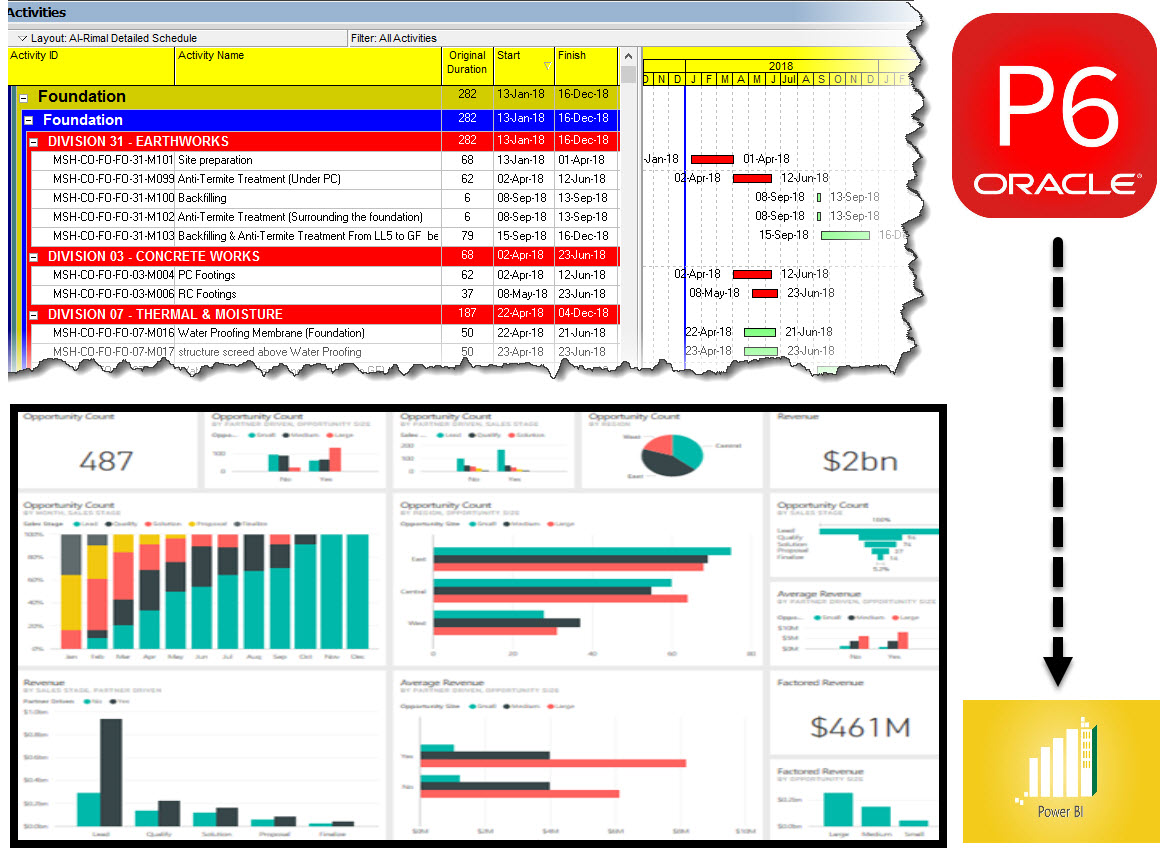
    Construction, manufacturing, energy, and IT businesses rely on accurate project planning and execution to be successful. Primavera P6 is a powerful tool for project managers, but it can be difficult to get the most out of its capabilities without help from experts. Fortunately, Power BI can provide the insights you need to make the most of your Primavera data. Let’s take a look at how these two technologies can work together to improve your projects.

    Introducing Primavera P6 and Power BI

    Primavera P6 is a construction management software application that enables users to schedule and track construction projects. The software is used by project managers and planners to create and monitor project schedules, resources, budgets, and risks. Power BI is a business intelligence tool that helps users to visualize and analyze data. The two tools can be used together to provide insights into construction projects. For example, Power BI can be used to create visualizations of project data that can be used to identify trends and areas for improvement. Primavera P6 can then be used to create detailed schedules and resources plans based on these insights. Together, these tools can help construction professionals to better manage their projects and improve their results.

    What data can be extracted from Primavera P6 and analyzed in Power BI?

    Power BI is a Microsoft business analytics tool that can be used to extract data from various sources in order to create interactive visualizations and reports. One such data source is Primavera P6, a construction project management software. By connecting Power BI to Primavera P6, users can gain insights into their construction projects that would otherwise be unavailable. For example, Power BI can be used to track the progress of individual tasks, identify bottlenecks in the project timeline, and predict when the project will be completed. In addition, Power BI can also be used to monitor resource usage and identify areas where cost savings can be achieved. By harnessing the power of Power BI, construction managers can gain a better understanding of their projects and make more informed decisions.

    How to create reports and dashboards with Primavera P6 data in Power BI

    The first step is to connect to your Primavera P6 database using the Power BI Desktop application. Once you have connected to the database, you will be able to select the data that you want to include in your report or dashboard.

    Once you have selected the data, you can then start to create your visualizations. Power BI provides a wide range of visualization options, so you can tailor your reports and dashboards to meet your specific needs. For example, you could create a bar chart to track project progress, or a pie chart to compare costs across different project phases.

    Once you have created your visualizations, you can then publish your reports and dashboards to the Power BI service, where they can be shared with others in your organization. Publishing to the Power BI service also allows you to take advantage of features such as scheduled refresh, which ensures that your reports and dashboards are always up-to-date with the latest data from Primavera P6.

    Tips and tricks for getting the most out of Primavera P6 and Power BI Integration

    Here are some tips and tricks for getting the most out of Primavera P6 and Power BI:

      • Use Power BI to create custom reports for your Primavera P6 data. This way, you can easily visualize important information and identify trends.

      • Take advantage of the Data Model Explorer in Power BI to better understand the relationships between different data sets.

      • Use the Query Editor in Power BI to transform and cleanse your data before creating reports or dashboards.

      • Use conditional formatting in Power BI to highlight key data points or visually flag issues.

    By following these tips, you can get the most out of Primavera P6 and Power BI. With these tools at your disposal, you’ll be able to manage your projects more effectively and make better decisions for your business.

    So, there you have it- a quick introduction to Primavera P6 and Power BI. I hope this has given you some ideas about the kinds of reports and dashboards you can create with data from your projects in Primavera P6. In future posts, we’ll explore more specific topics related to working with Primavera data in Power BI, so stay tuned! If you have any questions or comments on this topic, please let me know in the comments below.

  • Best PMO Systems  Solutions for Construction

    Best PMO Systems Solutions for Construction

    Oracle’s Primavera products are the leading construction program management solutions for the industry.For more than 25 years, Primavera solutions have helped construction, architecture, and engineering firms effectively plan, manage, control, and deliver projects on time and within budget.

    Whatever the size of a project, Oracle’s Primavera enterprise project portfolio management solutions will:

      • Effectively manage time, costs, resources, contracts, and changes in a single solution.

      • Get timely, accurate data for optimum decision-making.

      • Access information any time, anywhere.

      • Respond in real time to changing conditions.

      • Prevent and protect against claims.

      • Track and evaluate subcontractor performance.

      • Capture and standardize best practices.

      • Improve operational efficiency.

      • Reduce performance risk.

      • Proactively manage projects.

      • Accurately forecast to completion.

      • Improve project team collaboration.

      • Develop, capture, and implement the right risk mitigation strategies.