


Delay analysis in construction projects is the forensic exercise of working out which events pushed the completion date out, who is contractually responsible, and how many days each party has to answer for. It is the backbone of every extension of time submission, every liquidated damages defence, and every dispute that lands in front of an adjudicator or arbitrator. Research from McKinsey found that poor execution caused cost and time overruns in 73% of troubled megaprojects studied, and nine out of ten megaprojects worth more than one billion dollars ran over budget.[1] The method chosen to analyse those delays will decide how much of the damage falls on the contractor, the owner, or nobody at all.
Two documents dominate the professional conversation. The Society of Construction Law Delay and Disruption Protocol, Second Edition (February 2017), sets out how delay should be analysed and recorded in a way that stands up in dispute resolution. AACE International Recommended Practice 29R-03 catalogues nine Methods of Implementation (MIPs) that cover every realistic combination of timing, data quality and modelling approach. This guide maps the methods both frameworks recommend, explains when each one works, and shows how to choose between them when the contract, the data and the audience all pull in different directions.
What is delay analysis in construction projects?
Delay analysis in construction projects is the systematic process of examining the as-planned and as-built schedules, identifying each event that affected the critical path, apportioning responsibility for every day of slippage, and quantifying the resulting time impact in a form that a contract administrator, a dispute board or an arbitrator will accept. It is a retrospective or near-real-time forensic exercise, not a scheduling exercise. The planner builds the schedule. The delay analyst dissects what went wrong with it.
There is an important distinction to draw between delay analysis and delay management. Managing delay is the daily grind of coordinating trades, chasing submittals, escalating RFIs, running pull plans and keeping the project moving. Analysing delay is what happens when the time overrun has to be paid for. One is operational. The other is contractual and evidential.
Delay analysis typically serves three purposes on a construction project. The first is supporting a contractor’s extension of time (EOT) claim and any associated prolongation cost claim. The second is defending an owner against a contractor claim, or justifying liquidated damages against a late contractor. The third is resolving disputes between parties, whether through mediation, adjudication, expert determination, arbitration or litigation. The commercial stakes are large enough that research from McKinsey found rail megaprojects alone averaged a 44.7% cost overrun, with demand overestimated by 51.4%, and when those figures collide with a fixed completion date the result is almost always a claim.
Common causes of delay in construction projects
Most project teams can list the causes of construction project delays without much prompting, because they see the same ones repeat across jobs. Grouping them by who bears the risk is the fastest way to a clean analysis later.
Owner-caused delays. Scope changes after the baseline is locked. Late approvals of submittals and shop drawings. Design errors or incomplete drawings that generate avalanches of RFIs. Slow or missed progress payments. Delayed site access, owner-furnished equipment arriving late, late decisions on finishes or fit-out variations. A particularly costly pattern is when a change is issued with time added only for the RFI response, nothing added for the extra procurement or rework the change triggers. The schedule is then ruined in silence for weeks before it becomes visible.
Contractor-caused delays. Insufficient manpower, especially on specialist trades that cannot be backfilled from the street. Poor subcontractor prequalification. Subcontractor failure to perform despite proper notices. Rework caused by quality failures. Inadequate planning at the front end, where limits, scope and interfaces are not finalised before work starts. Logistics and procurement missteps such as ordering the wrong rebar or failing to secure backup suppliers before the primary one runs into trouble.
Neutral or external delays. Extreme weather, force majeure events, pandemics, strikes, unforeseen ground conditions, utility relocations that run long, permitting bottlenecks and global supply chain disruption. Approvately 30% to 50% of delays on complex projects involve at least one external cause even when the ultimate responsibility sits with the contractor or owner, according to industry commentary on causes of overruns.
The cause of a delay matters because it determines who bears the time and money. The method you choose to analyse the delay has to be capable of isolating that cause on the critical path. A method that aggregates all slippage into one bucket will not survive the first serious challenge from the other side.
Types of construction delays
Before a method can be chosen, every delay on the project has to be classified. Four category pairs do most of the work, and every delay event sits on each of them at the same time. A single event might be critical, excusable, compensable and concurrent all at once, and each attribute changes what the contractor is entitled to.
| Delay type | Definition | Contractual effect |
|---|---|---|
| Critical vs non-critical | A critical delay affects an activity on the longest path to completion. A non-critical delay affects an activity with float. | Only a critical delay shifts the completion date and so supports an EOT. Non-critical delays may still support disruption and prolongation of a sub-network. |
| Excusable vs non-excusable | An excusable delay is one the contractor did not cause and could not reasonably prevent. A non-excusable delay is the contractor’s own doing. | An excusable delay supports an EOT. A non-excusable delay exposes the contractor to liquidated damages. |
| Compensable vs non-compensable | A compensable delay is excusable and caused by the owner or their agents. A non-compensable delay is excusable but caused by a neutral event. | Compensable delays support both time and money (prolongation costs). Non-compensable delays support time only. |
| Concurrent | Two or more independent delays overlap in time, where at least one is the contractor’s and at least one is the owner’s or neutral. | Generally time but no money. The SCL Protocol recommends apportionment or the dominant cause test depending on the facts. |
In practice the characterisation of each delay is where disputes begin. Owners read ambiguous events as contractor-caused. Contractors read the same events as excusable or compensable. The choice of analysis method must be able to show the characterisation on the critical path, not merely assert it in a narrative.
The six delay analysis methods (SCL Protocol-aligned)
The SCL Delay and Disruption Protocol recognises six main methods, and AACE RP 29R-03 catalogues nine variations under its MIP numbering. The six below are the ones that matter in practice. Each has a place, and each fails in a different way. The right choice is almost always set by two things: the quality of the schedule data, and whether the analysis is being prepared during the works or after completion.
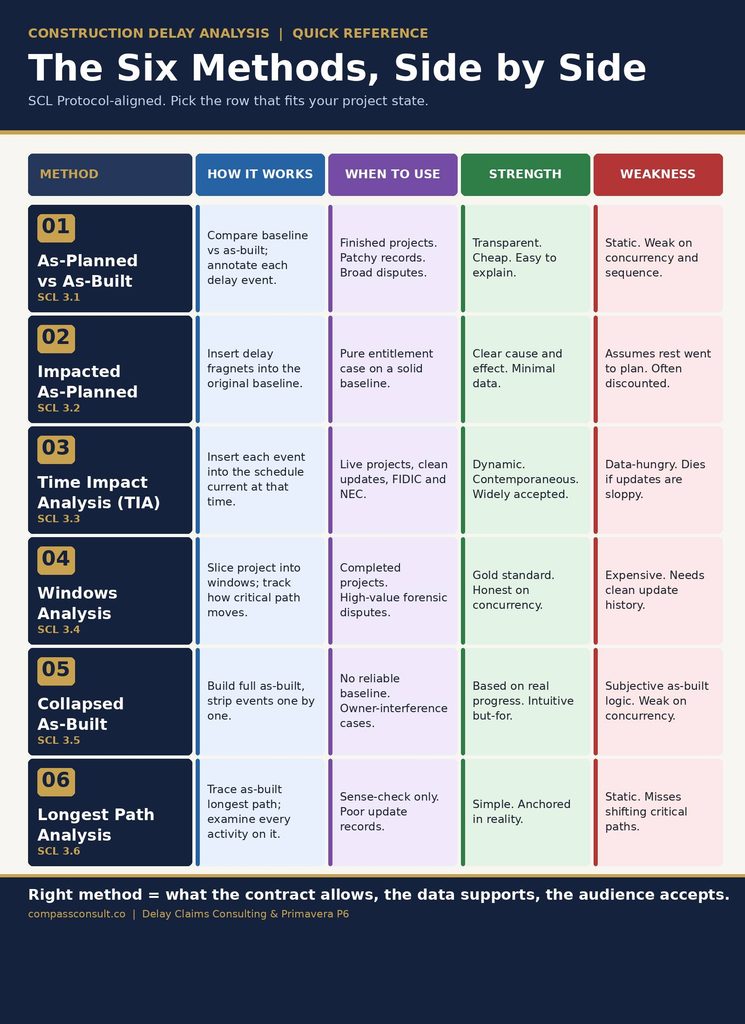
As-Planned vs As-Built (SCL Method 3.1, AACE MIP 3.1)
How it works. The baseline schedule is compared directly against the as-built schedule, and the differences are annotated event by event. Delay periods are identified and allocated to each party based on the contemporaneous records.
When to use it. For straightforward disputes where the schedule data is incomplete, the project is finished, and the disagreement is about broad strokes rather than specific days. It is also the fallback when the baseline was never properly updated.
Strengths. Transparent. Easy to explain to a non-technical audience. Cheap to run. Does not require the original planning software.
Weaknesses. Does not model the critical path dynamically. Vulnerable to the charge that it ignores the sequence in which the delays actually happened. Weak on concurrency.
Impacted As-Planned (SCL Method 3.2, AACE MIP 3.2)
How it works. Delay events are inserted into the original baseline schedule as fragnets, and the schedule is recalculated to show what the completion date would have been if only those delays had occurred. The difference between the baseline finish and the impacted finish is the claimed EOT.
When to use it. For a pure entitlement argument from a contractor who wants to isolate owner-caused delay on an otherwise well-planned baseline. Also used by owners to test the contractor’s case.
Strengths. Shows cause and effect clearly. Requires only the baseline and a list of events.
Weaknesses. Assumes everything else on the project went to plan, which it rarely did. Tribunals routinely discount it unless corroborated by a retrospective method. The SCL Protocol lists it as a weaker method precisely for this reason.
Time Impact Analysis / TIA (SCL Method 3.3, AACE MIP 3.3 and 3.4)
How it works. Each delay event is inserted into the schedule current at the time of the event, as a fragnet, and the schedule is forward-projected. The cumulative impact of each event is measured against the then-current completion date. TIA is the method of choice for contemporaneous analysis during the project.
When to use it. During the works on a live project with a well-maintained schedule, especially under FIDIC and NEC forms where EOT claims are expected to be submitted contemporaneously. Also for dispute analysis where the schedule updates are clean and signed off.
Strengths. Dynamic. Respects the schedule as it actually was when each event happened. Widely accepted by tribunals.
Weaknesses. Data-hungry. Falls apart if the monthly updates were sloppy or missing. Modelling choices can be challenged.
Windows Analysis / Time Slice (SCL Method 3.4, AACE MIP 3.5 and 3.6)
How it works. The project is sliced into contiguous time windows, usually matching monthly updates. Within each window the critical path as it existed at the start and end is examined, and delays within the window are allocated based on what moved the critical path. Windows analysis is widely considered the gold standard for forensic retrospective analysis.
When to use it. For completed projects with a reasonable history of monthly updates. For high-value disputes heading to arbitration where defensibility matters more than speed. It is the method most forensic delay experts reach for first.
Strengths. Captures how the critical path shifted over time. Allocates concurrent delays honestly within each window. Robust under cross-examination.
Weaknesses. Expensive and time-consuming. Requires clean updates, or significant reconstruction work when they are missing.
Collapsed As-Built / But-For (SCL Method 3.5, AACE MIP 3.7)
How it works. The as-built schedule is built in full, then selected delay events are stripped out one at a time, and the schedule is recalculated to show what the finish date would have been “but for” those events. The difference is the impact attributable to the stripped events.
When to use it. For retrospective analysis where there was no reliable baseline, or where the baseline was overtaken by events. Useful for showing what a contractor would have achieved without owner interference.
Strengths. Based on actual progress rather than planned intent. Intuitive answer to the question, what would have happened if the owner had not done X.
Weaknesses. Depends heavily on the quality of the as-built reconstruction. Logic has to be re-imposed on the as-built, which is open to challenge. Weak on concurrency unless combined with windows.
Longest Path Analysis (SCL Method 3.6, AACE MIP 3.9)
How it works. The as-built longest path through the project is traced, and each activity on that path is examined for cause of delay. Delays off the longest path are discounted unless they consumed float sufficient to put the activity onto the critical path later.
When to use it. As a sense-check against the other methods. Occasionally as a primary method where schedule updates are too poor to support windows analysis but the as-built sequence is reasonably clear.
Strengths. Simple to describe. Anchored in what actually happened.
Weaknesses. Static. Does not handle shifting critical paths or near-critical paths well. A path can appear critical only in hindsight.
Prospective, retrospective and forensic delay analysis, what’s the difference?
The industry uses three timing labels for delay analysis, and they are often confused in conversation even though the distinctions matter contractually. Prospective analysis is done during the works, usually by the contractor’s planner, to support an EOT application submitted contemporaneously under the contract. Retrospective analysis is done after completion to review what actually happened, typically as part of a final account exercise or an internal review. Forensic delay analysis is the subset of retrospective work commissioned specifically for dispute resolution, expert determination, adjudication, arbitration or litigation, and it is prepared to the standard a tribunal or arbitrator will accept and interrogate.
| Approach | Typical methods | When commissioned | Typical audience |
|---|---|---|---|
| Prospective | Time Impact Analysis, impacted as-planned | During the works, usually within the contract notice window for each event | Engineer, contract administrator, project manager, dispute avoidance board |
| Retrospective | Windows analysis, collapsed as-built, as-planned vs as-built, longest path | After practical completion, during final account or internal review | Senior management, auditors, owner’s representative |
| Forensic | Windows analysis, collapsed as-built, often combined | Once a dispute has crystallised, for use in formal proceedings | Adjudicator, dispute adjudication board, arbitrator, judge, expert |
In plain language, forensic delay analysis is retrospective analysis that is written to be defended. The analyst assumes every assumption will be cross-examined, every entry in the schedule will be challenged, and every decision about the critical path will be probed. The methodology, the data sources and the judgement calls all have to stand up to that scrutiny.
Which delay analysis method should you use? A decision framework
The honest answer is that the right method is dictated by five inputs rather than taste: what the contract requires, how clean the schedule data is, how much the dispute is worth, who the audience is, and what documentation survived the project. Running the wrong method on a mismatched project state is the single fastest way to lose an otherwise winnable claim.
| Project state | Recommended method | Why | Alternative | Risks |
|---|---|---|---|---|
| Live project, current baseline and clean monthly updates | Time Impact Analysis | Contemporaneous, dynamic, expected under FIDIC and NEC forms | Impacted as-planned for narrow entitlement questions | Over-modelling future events the schedule has not yet seen |
| Live project, poor or missing updates | Impacted as-planned, with notice of data limitations | Baseline survives; the rest can be reconstructed as needed | Rebuild updates, then TIA | Opponents will argue the baseline is no longer representative |
| Completed project, good records and signed-off updates | Windows analysis | Captures shifting critical path; robust under challenge | Collapsed as-built as a sense-check | Cost and time to prepare; data reconstruction for gaps |
| Completed project, poor records | Collapsed as-built | Based on as-built facts rather than planned intent | Longest path as a sense-check | As-built logic is subjective; concurrency hard to show |
| High-value dispute heading to arbitration | Windows analysis combined with collapsed as-built | Two independent methods converging on the same answer is hard to challenge | Single method with clear documentation of why | Expense; the two methods disagreeing opens new fronts |
The five decision inputs behind that table deserve a moment each. Contract requirements often prescribe the method. NEC contracts expect TIA inside the contract period. FIDIC 2017 Sub-Clause 20.1 sets the notification and particularisation regime. Many bespoke contracts name a method outright. Running an unapproved method is the first thing the other side will challenge. Schedule data integrity governs everything that follows. The DCMA 14-point check is the industry baseline for assessing whether a schedule is fit to analyse. If the schedule fails the check, the analysis itself is contestable regardless of the method. Dispute value decides how much is sensible to spend. A six-figure claim does not usually justify a six-figure forensic exercise. A nine-figure claim does. Audience matters because a contract administrator can follow a complex TIA, while a non-technical executive needs an as-planned vs as-built story to understand what happened. Documentation is the ceiling on what any method can prove. Without contemporaneous records, every method degrades, and the analyst ends up reconstructing facts the parties should have captured in real time.
Concurrent delay, the hardest question in delay analysis
Concurrent delay is where delay analysis loses most of its clean edges. The classic case is two independent delays, one caused by the contractor and one by the owner, that run over the same window and each would, on their own, have delayed completion. The entitlement question becomes whether the contractor gets time, whether the contractor gets money, and whether the owner can levy liquidated damages.
Three approaches dominate the legal treatment. The prevention principle says an owner cannot claim liquidated damages for a period it also caused, so time is granted to the contractor. The approach under English law following Henry Boot Construction v Malmaison Hotel (1999) and later confirmed in Walter Lilly v Mackay (2012) is that where two concurrent causes of delay operate, one of which is an owner risk event, the contractor is entitled to an extension of time for the full period. The SCL Protocol 2nd Edition takes a different line: it recommends apportionment where the facts support it, and concurrent delay normally gives the contractor time but no prolongation costs. Non-GC parties on the receiving end of a concurrent delay are also normally entitled to a schedule extension equal to the duration of the GC-caused portion.
In practice the characterisation of events as concurrent is where disputes are won and lost. What looks concurrent from a distance often resolves on closer analysis into a sequential chain where one party’s delay started first and caused the other’s delay to matter. Windows analysis and TIA are the two methods best equipped to show which is which. An as-built method without a dynamic critical path will not resolve concurrency credibly.
Building a defensible delay analysis
Four factors decide whether a delay analysis will hold up when it matters. Each of them is built during the project, not at the end, which is why experienced contract managers obsess about documentation from the first week on site.
- Contemporaneous records. Daily diaries, correspondence, meeting minutes, RFIs, submittals, photographs with dates, delivery dockets, manpower returns, inspection records, notices served and responded to. The guiding rule most seasoned PMs repeat is document, document, document. One formal practice that pays for itself is issuing a written note the moment a client, consultant or trade misses a date, confirming the impact and the recovery expectation. When the dispute arrives twelve months later that email chain is often the whole case.
- Schedule integrity. A schedule that fails the DCMA 14-point check is not analysable. Open-ended activities, missing predecessors, excessive negative float, hard constraints covering up late finishes, and float values that make no physical sense will all be used against the analyst. A clean baseline, regular updates, and a signed change log to carry baselines forward through scope changes are the minimum.
- Methodological consistency. The method chosen at the start of the analysis has to be applied the same way for every delay event. Switching methods partway through, or using different methods for owner-caused and contractor-caused events, lets the other side argue cherry-picking. The method should be stated plainly in the report and applied visibly.
- Independence of the analyst. For forensic work, the analyst’s independence is as important as their technique. Credentials matter here. AACE International’s Planning and Scheduling Professional (PSP) and Certified Forensic Claims Consultant (CFCC), RICS Accredited in Project Scheduling (APS), and PMI Scheduling Professional (PMI-SP) are the credentials tribunals expect to see.
A defensible analysis is one that a competent opposing expert would reach similar conclusions on when given the same data. If the methodology, the data and the judgement calls would not survive that test, the analysis is not ready to leave the office.
Running delay analysis in Primavera P6
Most serious delay analysis on construction projects runs on Oracle Primavera P6. The reason is not loyalty. It is that P6’s enterprise data model, baseline management and schedule logging are built for exactly this kind of forensic work, and most planners who lead delay claims are certified in it.
The practical workflow for an experienced planner looks like this. A clean approved baseline is saved in Primavera P6 on day one and locked. Monthly updates are maintained with both actuals and the planned-remaining re-scheduled, so each update is a full snapshot of the critical path as it stood that month. Claim Digger is used to compare any two schedules and identify every change to logic, durations, constraints and resource loading between them, producing an audit trail that is often decisive in dispute. The Schedule Log captures scheduling warnings and errors each time the schedule is recalculated, which is important evidence that the schedule was run and reviewed at the time rather than reconstructed later. When a delay event occurs, the analyst builds a fragnet for it in P6, inserts it as a what-if scenario using baselines or copied projects, and the impact on the critical path is measured directly off the software.
For retrospective windows analysis, the planner slices each month into a window, runs the schedule as it stood at the start of the window, overlays what actually happened during it, and attributes each day of slip. P6’s layouts and filters make this tractable. For collapsed as-built work, the as-built activities are entered against a copied baseline project and events are stripped one at a time. Exporting the critical path report straight from P6 for inclusion in the claim submission is the final step most contract administrators expect.
This is the part of the job that cannot really be done well in a spreadsheet. The work can be sketched in Excel, the inputs can be tracked in Excel, but the critical path arithmetic needs the scheduler. This is why so many serious delay-claims engagements are led by planners with P6 experience rather than general claims consultants with scheduling as a side skill. Compass Consult’s planning and scheduling services and Primavera P6 EPPM licensing support both sides of this: the people and the software.
Common mistakes that collapse delay claims
Most delay claims that fail do so for predictable reasons. Running through this list before submission has saved more claims than any single modelling technique.
- Late or missed notices. Almost every standard-form contract requires notice within a defined window for each delay event. Miss the window and entitlement can be lost outright even when the delay was unquestionably compensable. Issue the notice early, issue it in writing, and issue it to the right addressee.
- Poorly maintained schedule updates. A baseline without monthly updates is a static picture of intent. Without updates there is nothing to show how the critical path moved. A claim built on a single baseline looks naive to a tribunal.
- A baseline that does not match the contract. Baselines are often negotiated after the fact and never signed off formally. A disputed baseline is the first thing opposing counsel will attack.
- Picking a method the contract does not allow. Running a windows analysis when the contract specifies TIA, or vice versa, is an easy challenge to raise.
- Ignoring concurrency. Claiming the full period against the owner when the contractor also delayed over part of it invites a wholesale discount from the tribunal.
- Mixing methods for different events. Using TIA for owner-caused events and as-planned vs as-built for contractor-caused events reads as cherry-picking.
- Submitting without peer review. A second qualified analyst reviewing the methodology and the outputs catches errors that otherwise end up in cross-examination. Even internally, a cold read by someone not attached to the project is worth the hour.
Frequently asked questions
What is forensic delay analysis in construction?
Forensic delay analysis is retrospective delay analysis prepared to the evidential standard required in dispute resolution. It combines windows analysis, collapsed as-built or other recognised methods with contemporaneous records so the methodology, data and conclusions can withstand cross-examination by an opposing expert in adjudication, arbitration or court.
What are the four main types of construction delays?
The four pairings used in practice are critical vs non-critical, excusable vs non-excusable, compensable vs non-compensable, and concurrent. Every delay event sits on each of them, and the combination decides whether the contractor gets time, money, both, or neither.
What does a construction claims consultant do?
A construction claims consultant prepares, reviews or defends delay, disruption and quantum claims under construction contracts. The work includes schedule analysis, contract interpretation under FIDIC, NEC or bespoke forms, drafting of claim submissions and responses, and acting as an expert witness in formal proceedings. For many disputes the claims consultant is the party who makes the contractor’s or owner’s case stand up.
What is the difference between TIA and windows analysis?
Time Impact Analysis inserts delay events one at a time into the schedule current at the time of each event and projects forward, making it best for live or near-contemporaneous use. Windows analysis slices the project into contiguous periods and examines how the critical path moved within each one, making it stronger for retrospective and forensic work on completed projects.
Can delay analysis be done in Excel, or do I need Primavera P6?
Excel is useful for tracking inputs, cataloguing events and presenting results, but the critical path arithmetic that underpins TIA, windows analysis and collapsed as-built needs a proper CPM scheduler. Primavera P6 is the industry standard for serious claims work. Microsoft Project is sometimes used on smaller projects, though its enterprise baseline features are weaker. Excel on its own will not produce an analysis a tribunal will accept on anything of size.
Who is responsible for concurrent delay under the SCL Protocol?
The SCL Protocol 2nd Edition recommends that where a contractor delay runs concurrent with an owner delay, the contractor is entitled to time but not to prolongation costs for the concurrent period. English common law has a slightly different line, granting a full extension of time to the contractor where two independent causes operate simultaneously.
Which delay analysis method do tribunals prefer?
Tribunals prefer the method that best fits the facts of the project and the quality of the data, not a particular method in isolation. Windows analysis is the most-respected forensic method on completed projects with reasonable records. TIA is expected for live contemporaneous analysis under FIDIC and NEC. What tribunals consistently reject is a method chosen for convenience rather than fit.
How much does a delay analysis typically cost?
Cost scales with complexity, the number of events, the length of the project and the quality of the records that have to be reconstructed. A straightforward TIA on a well-documented live project may run in the low five figures. A full windows analysis on a completed multi-year project with poor records commonly runs into the six figures, which is still small compared to the amounts usually at stake.
Where this leaves you
Delay analysis in construction projects is not a methodological puzzle with a single right answer. The right method is the one the contract allows, the schedule data will support, and the audience will accept. Add proper documentation, a clean baseline, honest treatment of concurrency and an independent review, and the analysis becomes defensible even when the dispute is large. Skip any one of those four and even the best method will unravel in cross-examination.
If you are preparing an extension of time submission, defending against a claim or planning a forensic review, Compass Consult’s delay claims consulting team and Primavera P6 specialists can help you choose the right approach and build the record to support it.