Services

Delay Claims Consulting

Evidence-led delay claims consulting for construction owners, contractors and subcontractors. Our specialists analyse project schedules, contract requirements and project records to assess delay, investigate its causes and support extension of time claims and responses.
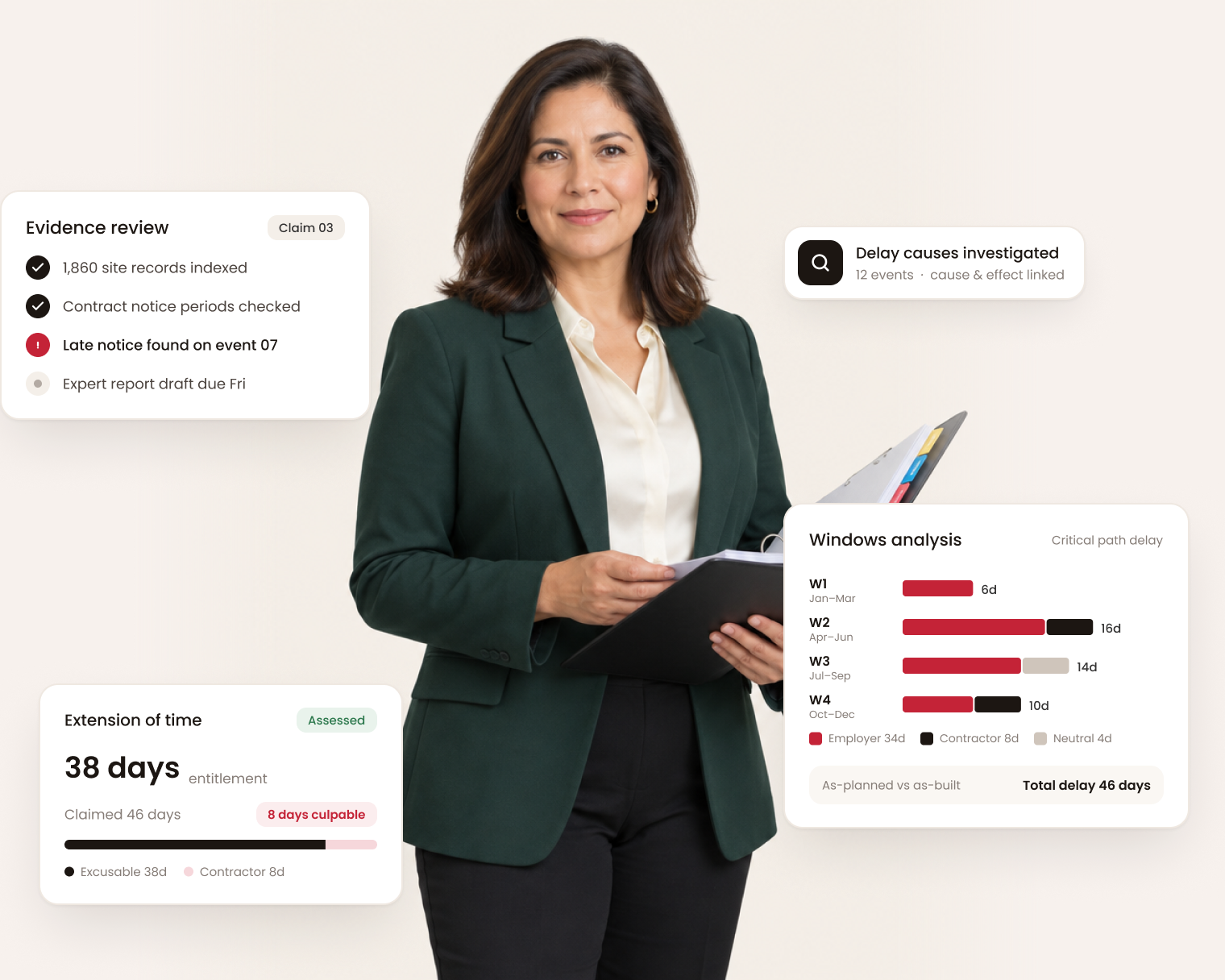
Delay analysis and claims evidence cards around a construction professional

What we offer

Construction Delay Claims Services

We help construction teams prepare, assess and respond to extension of time (EOT) and disruption claims. By reviewing the contract, project schedules and contemporaneous records, we assess the causes and effects of delay and provide evidence to support claim preparation, assessment and dispute resolution.

Extension of time claims

Prepare or assess extension of time claims by reviewing the relevant contract provisions, notices, delay events and schedule impacts. We help present the supporting analysis and evidence in line with the contract’s requirements.

Forensic delay analysis

Analyse project schedules and records to assess the timing, causes and effects of delay. Depending on the contract, available records and circumstances, we select an appropriate method, which may include as-planned versus as-built, time impact analysis, windows analysis or collapsed as-built analysis.

Disruption and concurrent delay

Assess disruption and productivity impacts, and analyse potential concurrent delay. We examine relevant project records and schedule evidence to distinguish the effects of different events and support a reasoned assessment of their time and cost implications.

Dispute support

Prepare clear analytical reports and schedule evidence to support negotiations, adjudication, mediation or arbitration. We can work alongside your commercial and legal teams to explain the schedule analysis and its findings.

Capability

Delay and extension of time claim support across building, mining and infrastructure projects, supported by detailed Primavera P6 schedule analysis.

How we help

Delay analysis built to stand up to scrutiny

A delay claim needs clear evidence and a reasoned analysis. We review the contract, baseline and updated schedules, and project records to select a method suited to the circumstances. Our findings explain the analysis, assumptions and limitations in a format that commercial teams, lawyers and decision-makers can understand. We draw on recognised industry guidance, including the Society of Construction Law’s Delay and Disruption Protocol and AACE International’s guidance on forensic schedule analysis.

From requirements to practical delivery.

We review the contract, baseline schedule, progress updates and available project records. Together, we agree the questions to be answered, the appropriate analysis method, the deliverables and the timetable. This helps align the analysis with your project’s contractual requirements and upcoming claim or dispute milestones.

FAQs

What clients ask us first.

What is forensic delay analysis?

Forensic delay analysis examines project schedules and records to assess what happened during a project, which events affected progress or completion, and the extent of their impact. It may use baseline and updated schedules alongside records such as site diaries, correspondence, progress reports and notices. The findings can support extension of time claims, claim assessments and dispute resolution, but contractual entitlement must also be considered.
There is no single best method. The right one depends on the contract, the quality of the schedules and records, the time available and whether the analysis is prospective or retrospective. Common delay analysis methods include impacted as-planned, time impact analysis, as-planned vs as-built, windows analysis and collapsed as-built.
An extension of time (EOT) claim is a request to extend a contractual completion date because of a delay event for which the contract provides time relief. The claim usually needs to demonstrate the relevant event, compliance with applicable notice and substantiation requirements, and the effect on completion. If an extension is granted, it may change the date against which delay-related contractual remedies are assessed. Any entitlement to delay costs is a separate question governed by the contract and applicable law.
Concurrent delay generally refers to overlapping delay effects from two or more events that may affect project completion during the same period. How concurrency is identified and treated depends on the facts, the contract and the governing law. Schedule analysis helps assess the timing and effects of the relevant events, but it does not by itself determine contractual entitlement.
Useful records may include the contract and amendments, baseline and updated schedules, progress and as-built information, site diaries, RFIs, variations, notices, correspondence and meeting minutes. The relevant records depend on the claim and the analysis method. Contemporaneous records can help establish what happened and when. If records are incomplete, we identify the limitations and explain what can reasonably be concluded from the available evidence.
We can support contractors and subcontractors preparing delay claims, as well as owners and other project representatives assessing them. The scope depends on the engagement and the records available. Our focus is on clear schedule analysis and evidence that helps the relevant parties understand the delay issues.
Proactive schedule management, timely assessment of delay events and good project records can help teams identify emerging issues, assess their potential impact and respond earlier. They can also improve the evidence available if a claim arises. Explore our Planning & Scheduling and Risk Management services for support with proactive project controls.

Our Plans

Flexible Options Tailored To Your Needs

Have a question or want to discuss your next project? Reach out to us and we’ll get back to you within 24 hours.

Engagement models

Fixed

A fixed price for the project or work, based on the work to be done. Suitable where all project inputs, specifications and requirements are defined.

Time & Material

Hourly rates based on the required work. Works well where not all inputs are readily available.

Dedicated Team

Retainer pricing based on the type of work and its duration. A dedicated team works as an extension of the client’s own team.

Send us a message

Reach out to us for plan enquiry and project discussion

Start a conversation

Make your next project
decision with greater
confidence.

Work with experienced specialists to strengthen project controls, implement the right technology and gain earlier visibility into schedule and cost risk.

Chart showing actual progress up to today, a range of forecast outcomes and the decision point TODAYRANGE OF OUTCOMESDECISION